Writing
Time Flies
On Sutapa Biswas, friendship and the birds that keep time
On a friendship of several years, an artist whose voice I have long held close, and a body of work that reaches into the psychological and the emotional.
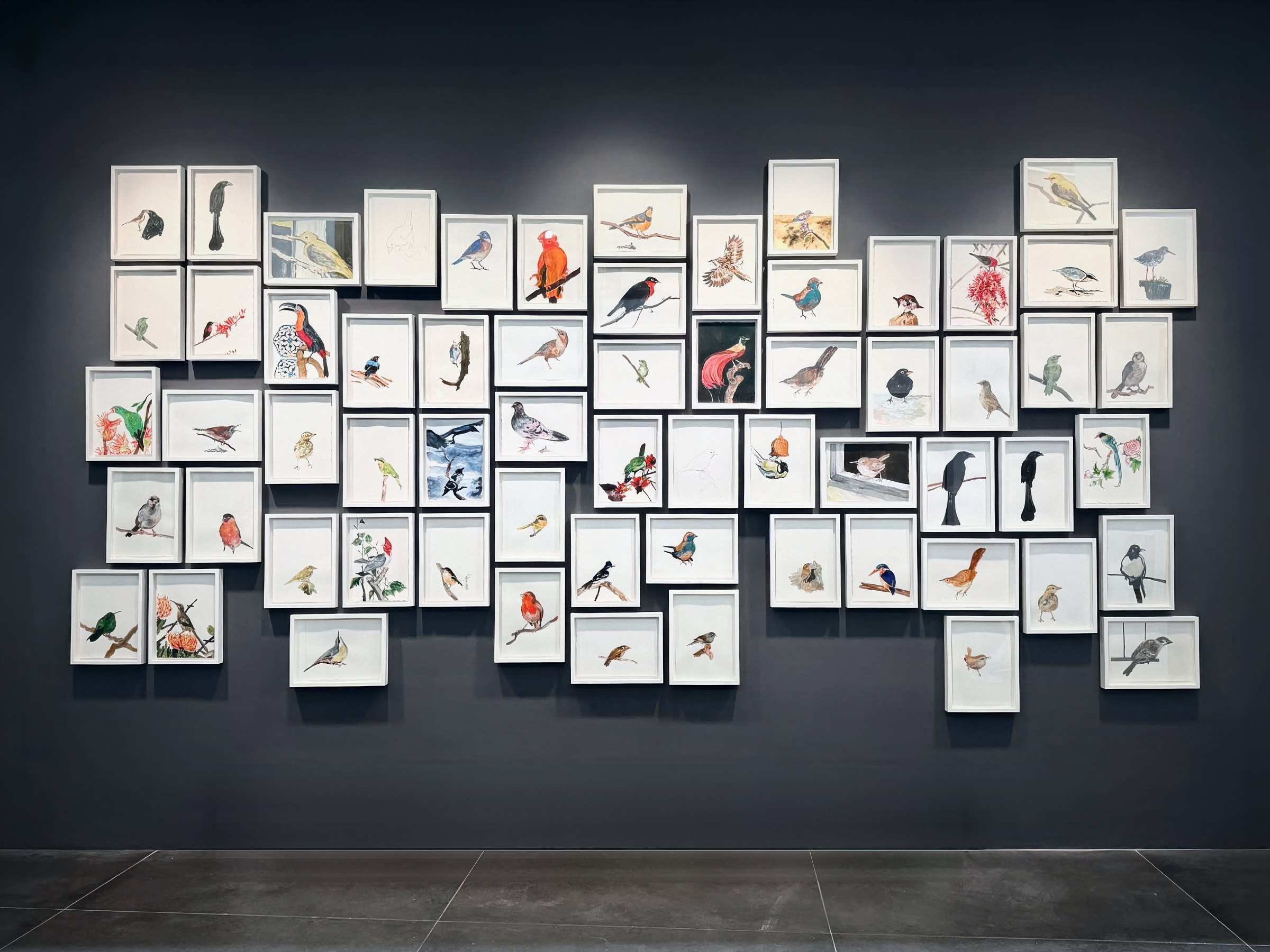
Sutapa Biswas, Time Flies, installation view.
© Sutapa Biswas. All rights reserved, DACS 2026.
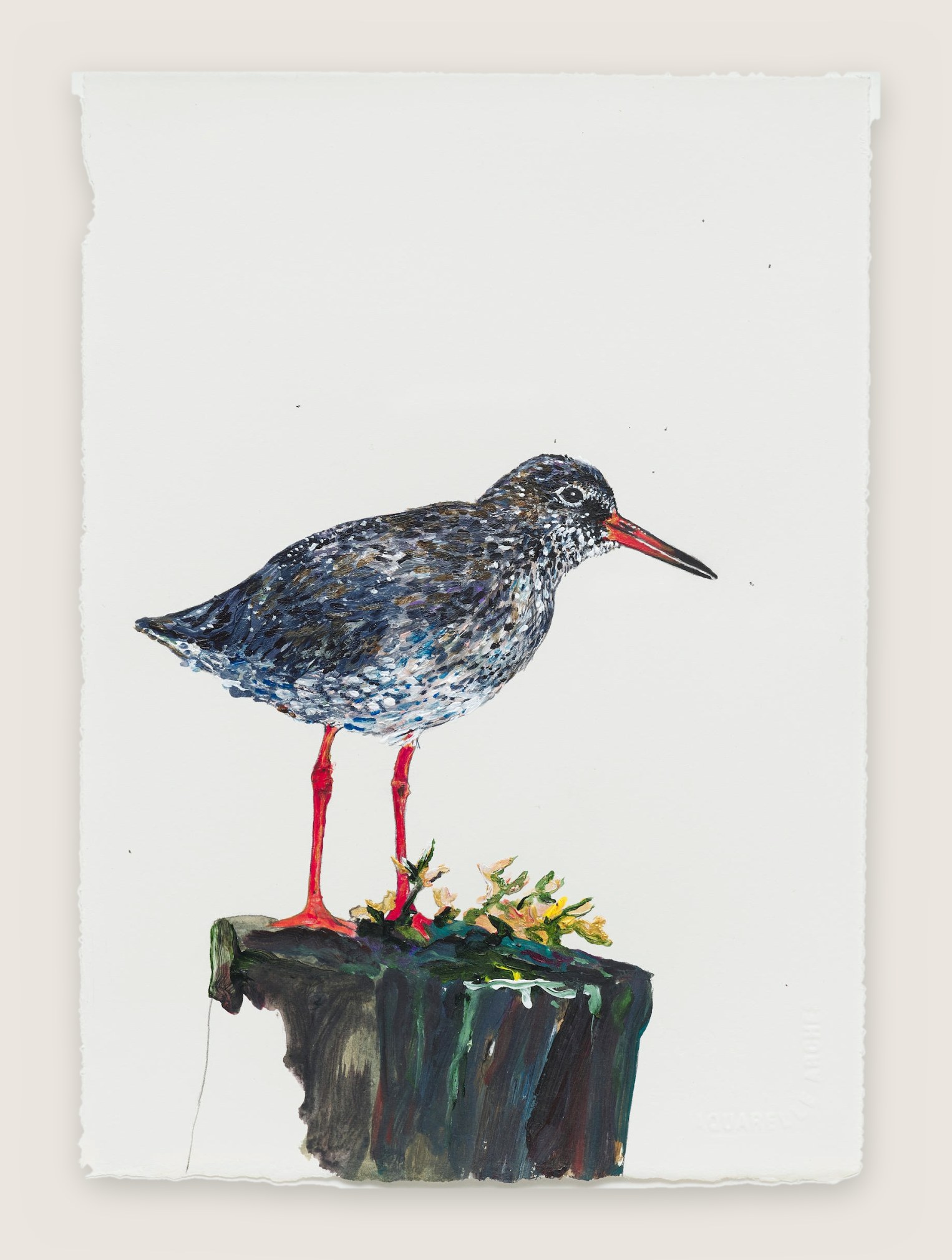
Sutapa Biswas, Time Flies 02.08.2023, 2023, acrylic and pencil on paper, 30 x 21 cm.
Joseph Clark Collection. © Sutapa Biswas. All rights reserved, DACS 2026.
Some artists you collect. Others you keep company with.
I have been touched by Sutapa Biswas’s work for a very long time, long before I knew her. It is work I return to, and measure other things against. There is a voice in it, steady, searching and unafraid of feeling, that I have held onto through many changes in my own life.
Over the last few years that admiration has become a friendship. It is rare for an artist’s work and an artist’s conversation to feel continuous with one another. With Sutapa they do. The same attention she gives to a feather or a petal, she gives to people, to history and to the questions that refuse to settle.
The first of her birds to come into the collection was Time Flies 02.08.2023, acquired in 2023 through the fundraiser for Hospital Rooms. It is a small painting of a redshank, red legs planted on a weathered post, its speckled body built from hundreds of tiny marks. It looks simple. It is not.
Her work does not ask to be understood quickly. It asks to be lived with.
Sutapa was born in Santiniketan, West Bengal, in 1962, and came to London with her family as a young child. She emerged in the 1980s as part of the British Black Arts movement, showing in The Thin Black Line, curated by Lubaina Himid at the ICA in 1985. Her monumental self-portrait as the goddess Kali, Housewives with Steak-Knives (1983–85), remains one of the defining images of that moment.
Since then she has moved across painting, drawing, photography and film, but the concerns have held: migration and displacement, colonial history, the inheritance passed between mothers and daughters, and the way the past keeps arriving in the present. Her film Lumen (2021) follows three generations of women, Sutapa, her mother and her grandmother, displaced under British rule in India.
What moves me is where she locates all of this. History, in her hands, is not a backdrop. It is felt in the body, carried in memory, held inside the family. Her work operates in a deeper, more psychological and more emotive register than most art that takes history as its subject. It does not lecture. It stays with you.
The birds
Time Flies began in 2000 and has never really stopped. It has grown into a polyptych of dozens of panels, birds imagined and birds drawn from photographs and archival paintings reaching back to the eighteenth century.
The series began with her father. In their last conversation before he died, they talked about the call of the woodpigeon in Proust, a sound that measures time and distance. After his death, the first sound she heard was birdsong. Each bird carries something of that conversation. The series has been described as an act of remembering, and that is how I experience it.
The titles are dates. A day is fixed, even as the phrase admits that days never stay.
That tension is everything I value in her work. The paintings are exact, patient and full of colour, and yet they are about loss and the passing of time. Tenderness and grief sit side by side, neither cancelling the other out.
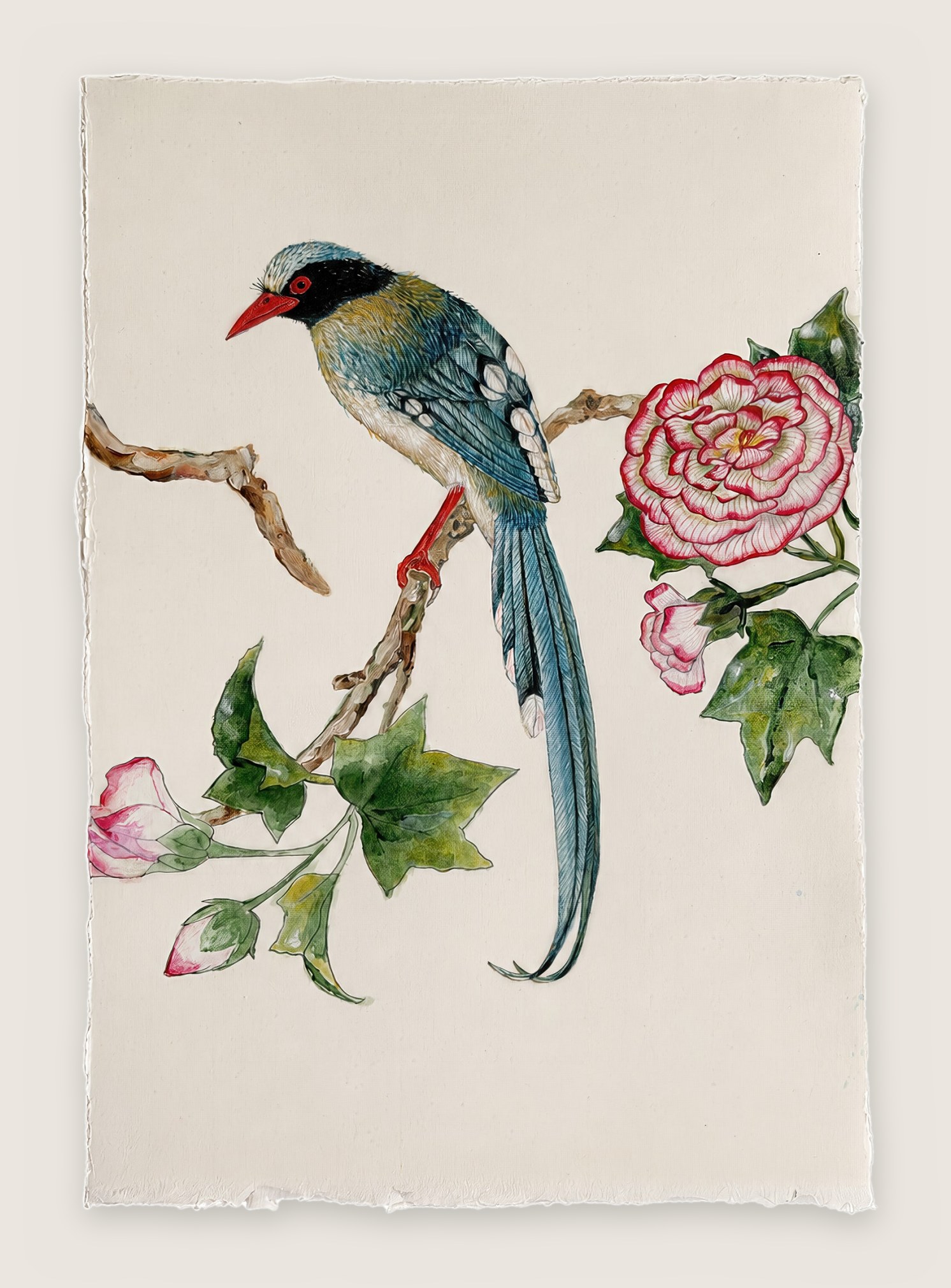
Sutapa Biswas, Blue bird with orange bill, 2025, acrylic and graphite on watercolour paper, 30.5 x 21.16 cm.
Joseph Clark Collection. © Sutapa Biswas. All rights reserved, DACS 2026.
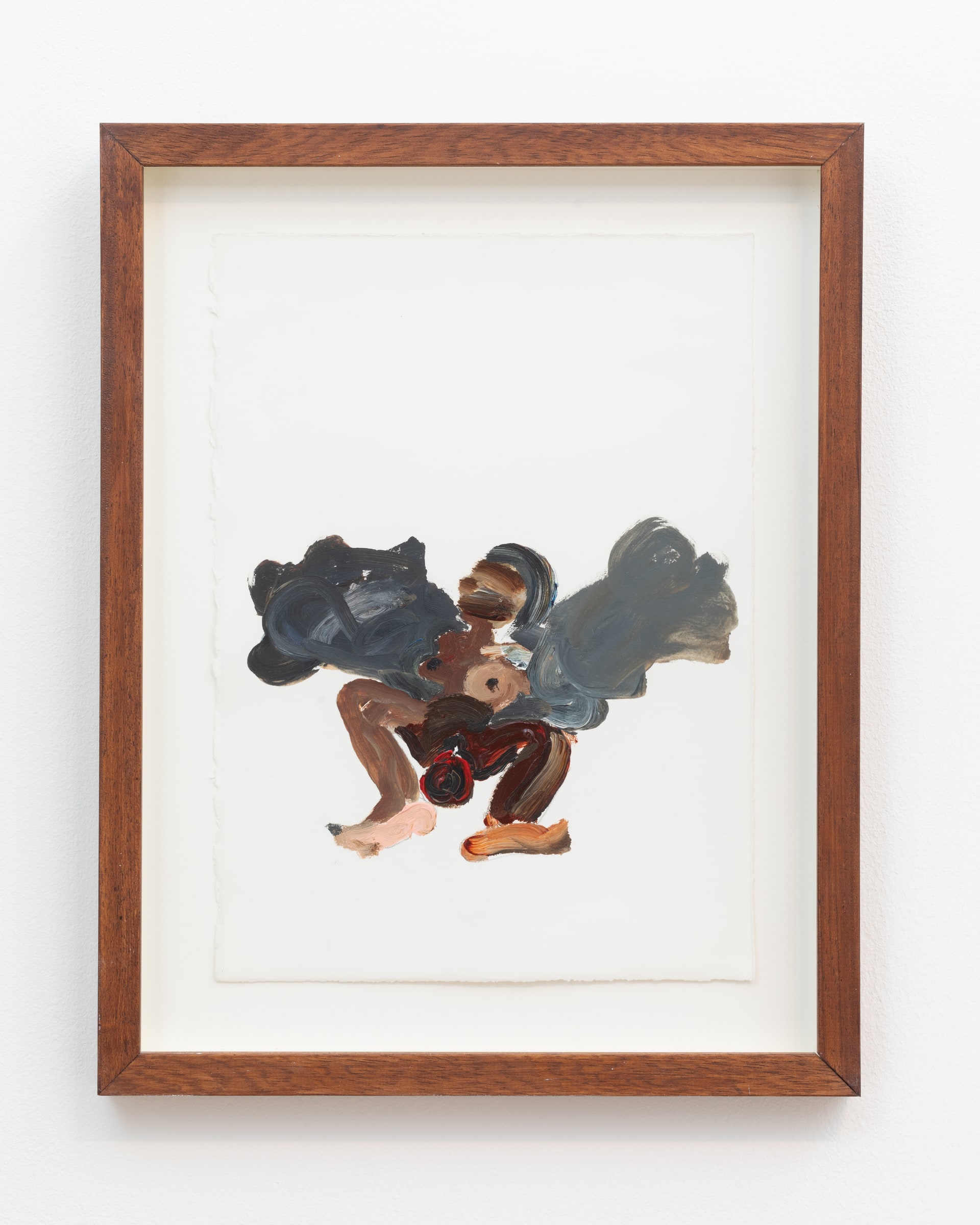
Sutapa Biswas, Magnesium Bird, 2006, acrylic and line drawing on watercolour paper, 29.5 x 21.5 cm.
Joseph Clark Collection. Photograph: BJ Deakin Photography. © Sutapa Biswas. All rights reserved, DACS 2026.
Blue bird with orange bill (2025) joined the redshank in the collection. A long-tailed bird perches among flowering branches, its bill and eye bright against carefully articulated feathers, the paper left open around it. Alongside them sits Magnesium Bird (2006), a much looser and more searching painting that Sutapa has connected to the birth of her son and to the change that came with becoming a mother.
Seen together, the three works span twenty years. They show an artist returning to the same creature to say very different things: about beginnings, about endings, and about the attention it takes to hold either.
In an earlier essay I described this collection as a field of dialogue rather than a hierarchy. Sutapa is one of the voices that taught me what that means. Living with her work is an ongoing conversation, and knowing her has only deepened it.
Ballad of the Flowers
This month I have lent both birds to Sutapa’s solo exhibition, Ballad of the Flowers, at East Gallery, Norwich University of the Arts, curated by Claire Allerton. At its heart is a major new film, Ballad of the Flowers, Chapter 1, funded by the Government Art Collection. Shot in Norwich’s Plantation Garden, it brings dance, performance and poetic monologue together to trace the histories of flowers through trade, power and empire.
Lending is part of what collecting means to me. The works do not belong only to the people who live with them. When an artist needs them, to complete a thought or to show how a practice has grown, they should go. It is a small way of returning the trust she placed in me when the works first came home.
Sutapa Biswas: Ballad of the Flowers runs from 6 November 2026 to 23 January 2027 at East Gallery, Cavendish House, St Andrews Street, Norwich. Entry is free.
Friendship and collecting are not so different. Both depend on attention, given freely and sustained over time. Both are tested by distance and renewed by return.
Sutapa’s birds remind me of that every day.
Time flies. What we hold onto is what we choose to keep.
In the collection
Sutapa Biswas
The three works discussed in this essay are held in the Joseph Clark Collection. Explore each record for full details, descriptions and further images.